
Subaru Forester: Maintenance and service / Brake fluid
Checking the fluid level
WARNING
- Never let brake fluid contact your eyes because brake fluid can be harmful to your eyes. If brake fluid gets in your eyes, immediately flush them thoroughly with clean water. For safety, when performing this work, wearing eye protection is advisable.
- Brake fluid absorbs moisture from the air. Any absorbed moisture can cause a dangerous loss of braking performance.
- If the vehicle requires frequent refilling, there may be a leak. If you suspect a problem, have the vehicle checked at your SUBARU dealer.
CAUTION
- When adding brake fluid, be careful not to allow any dirt into the reservoir.
- Never splash the brake fluid over painted surfaces or rubber parts. Alcohol contained in the brake fluid may damage them.
- Be careful not to spill brake fluid when adding it. If brake fluid touches the exhaust pipe, it may cause a bad smell, smoke, and/or a fire. If brake fluid gets on the exhaust pipe, be sure to wipe it off.
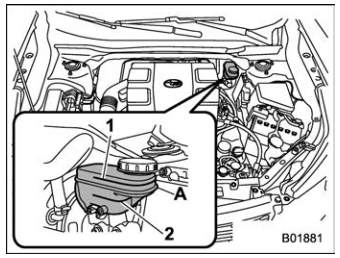
- “MAX” level line
- “MIN” level line
- The brake fluid level must be checked in this area.
Check the fluid level monthly.
Check the fluid level on the outside of the reservoir. Be sure to check the fluid level for the brake system at the shaded area in the illustration.
If the fluid level is below “MIN”, add the recommended brake fluid to “MAX”. Use only brake fluid from a sealed container.
Recommended brake fluid
Refer to “Fluids”.
CAUTION
Never use different brands of brake fluid together. Also, avoid mixing DOT 3 and DOT 4 brake fluids even if they are the same brand.

 Brake booster
The brake booster utilizes the vacuum
produced by the engine manifold to reduce
the force required to depress the brake
pedal.
The vacuum in the brake booster may be
insufficient if the brake pedal is depressed
when the engine is stopped or after the
vehicle has been parked for a long period
..
Other information:
Subaru Forester 2019-2026 Owners Manual: Operating conditions
The BSD/RCTA will operate when all of the following conditions are met. The ignition switch is in the “ON” position. The BSD/RCTA warning light and BSD/ RCTA OFF indicator light are turned off. The EyeSight warning indicator is off. The vehicle is driven at speeds above 7 mph (12 km/h) (except when reversing)...
Kia Telluride (LQ2, 2027-2026) Owner's Manual: Setting the power liftgate
The Kia Telluride allows you to customize several power liftgate functions for greater convenience. You can select your preferred opening speed and maximum opening height through the infotainment system. If you do not wish to use these features, they can be disabled in the settings menu...
Categories
- Manuals Home
- Automatic door locking/unlocking
- Disabling functions
- All-Wheel Drive warning light
- New on site
- Most important about car
How to get the source code using the open source
Free/Open Source Software Information
This product contains Free/Open Source Software (FOSS).
The license information and/or the source code of such FOSS can be found at the following URL.
http://www.globaldenso.com/en/opensource/ivi/subaru/
