
Subaru Forester: Navigation-based Smart Cruise Control (NSCC): (if equipped) / Navigation-based Smart Cruise Control limitations
The advanced Navigation-based Smart Cruise Control (NSCC) system equipped in your Kia Telluride is designed to proactively adjust your vehicle's speed using real-time map data. However, this sophisticated technology operates within defined boundaries. You should be aware that the system may function abnormally or exhibit unexpected behavior under the following specific conditions:
-
The onboard navigation system is experiencing a technical fault or is otherwise not functioning as intended.
-
Vital mapping and routing information fails to reach the cruise control module due to an error in the infotainment system display or the vehicle’s central processing unit.
-
Discrepancies exist between the digital map data and the physical road layout, often caused by outdated map files or errors in real-time GPS positioning data.
-
The navigation system is actively calculating or recalculating a route while the Kia Telluride is in motion, which may cause a temporary delay in speed adjustment data.
-
A disruption in satellite connectivity, such as while driving through long tunnels, parking structures, or dense urban canyons, which causes a loss of precise GPS signals.
-
Operating the vehicle in a geographical region where the navigation-based support features are not yet mapped or supported by the system.
-
When the infotainment system is prioritizing the interface for Android Auto™ or Apple CarPlay®, which may occasionally limit the transmission of native navigation data to the cruise control system.
-
The vehicle is approaching a curved road section that is located too close to the current vehicle position for the system to safely execute a gradual speed adjustment.
-
Navigating complex highway infrastructure where the main lanes split into multiple diverging paths and subsequently merge, causing potential confusion in route identification.
-
You are driving on a path that does not align with the active turn-by-turn guidance currently set in the Kia Telluride navigation system.
-
The destination is being modified or canceled mid-drive—including automatic re-routing triggered by live traffic updates—which resets the system's look-ahead parameters.
-
Entering or exiting highway rest areas, service plazas, or specialized pull-off zones, where the map data may not categorize the lanes as part of the "main" road.
-
When multiple lane splits or merges occur in rapid succession, preventing the system from maintaining a consistent "main road" lock.
-
Driving on newly constructed roads or temporary lanes that have not yet been reflected in the current navigation database.
-
The system is driving on roads for which there is no available digital map information, rendering the navigation-based speed adjustment feature inactive.
-
The external environmental sensors (radar and camera) are operating at their maximum detection limit due to high-traffic complexity or signal interference.
-
Road lane markings are faded, non-existent, or of such poor quality that the system cannot reliably map the current lane position.
-
The navigation system cannot discern the vehicle’s precise elevation or position, such as when driving on an elevated overpass that runs parallel to or directly above a surface-level road.
-
The vehicle’s navigation software is undergoing an background update while you are actively driving, which may temporarily suspend data processing.
-
The navigation system initiates an automatic restart due to a minor software glitch or power cycle while in operation.
-
You are traveling through road segments where speed limits are frequently changed or are currently inconsistent with the navigation system’s stored data.
-
The road is currently undergoing active construction, which often results in lane closures, detours, and altered traffic flows that deviate from standard map data.
-
Driving on roads with restricted access, military bases, or privately controlled facilities that are not mapped in the public navigation database.
-
Operating the Kia Telluride in severe weather conditions, including torrential rain, blinding snow, or dense fog, which hampers both the sensor suite and the reliability of navigation data.
-
Navigating through extremely tight or sharply curved roads that exceed the geometric parameters defined for automatic speed reduction.
|
|
-
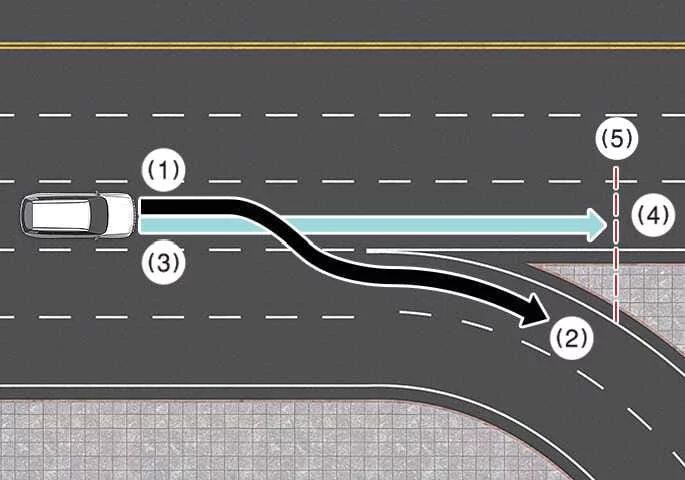
When there is a discrepancy between the navigation set route (branch line) and your current driving path (main road), the "Highway Curve Zone Auto Slowdown" may not activate until the Kia Telluride system successfully re-synchronizes and confirms the current road as the primary route.
-
If the vehicle identifies the path as a main roadway rather than the navigation-guided route, the "Auto Highway Speed Change" may trigger. However, the intensity of acceleration or deceleration may vary based on your distance to the curve and your current speed, potentially resulting in abrupt transitions.
|
|
-
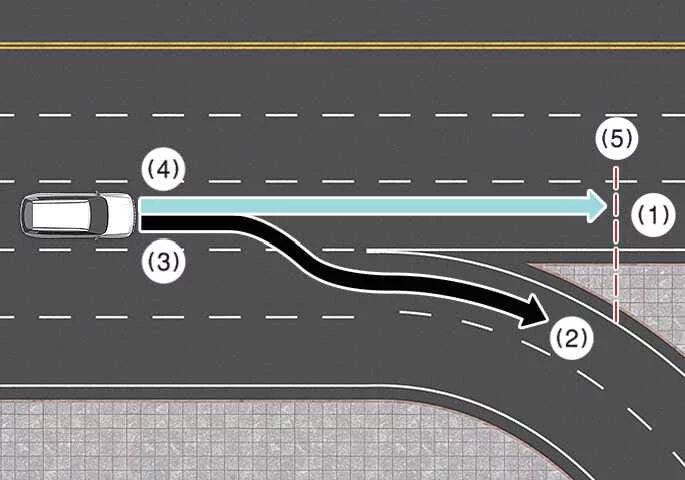
In cases where the navigation main road and your actual driving path (the branch line) differ, the "Highway Curve Zone Auto Slowdown" function may provide brief, temporary operation based solely on the main road's curve characteristics.
-
If the navigation system senses that you are exiting the highway via a junction or connector, the "Highway Curve Zone Auto Slowdown" function will be suppressed to avoid unnecessary braking.
|
|
-
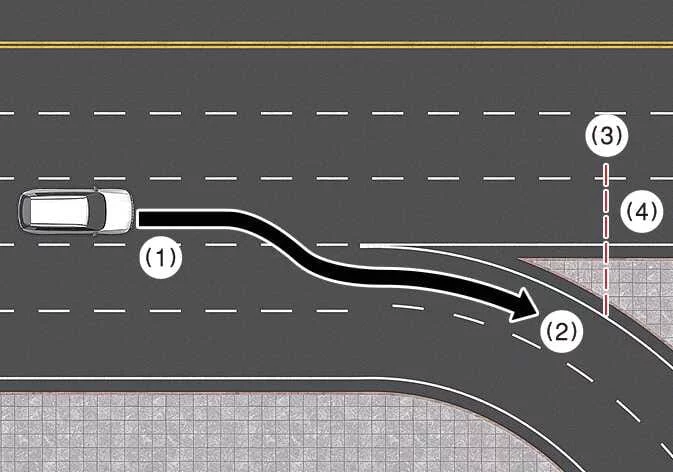
In the event that you do not define a specific navigation destination, the "Highway Curve Zone Auto Slowdown" in your Kia Telluride will still function by relying on default curve information mapped for the primary road.
-
Even after you have intentionally departed from the main road, the system may exhibit temporary speed reduction behavior if it still retains navigation data regarding the upcoming highway curved sections.
WARNING
-
The Navigation-based Smart Cruise Control is strictly a convenience-enhancing feature and is never a substitute for an attentive driver. You must always maintain visual contact with the road ahead, as the driver is ultimately responsible for adhering to all traffic regulations and safety requirements.
-
This system utilizes road data provided by the navigation database. Because speed limits are frequently updated by local authorities and may differ from your map’s internal data, it remains your personal responsibility to monitor and obey the actual speed limit signs posted on the road.
-
The "Auto Highway Speed Change" will automatically disengage when the Kia Telluride exits the primary lanes of a dedicated highway, specifically when entering surface-level national roads or transitioning into facilities like service areas, toll gates, or complex interchanges. Remain focused and ready to take manual control of the vehicle's speed.
-
Detection capability may be limited by the speed and movement of vehicles traveling directly in front of yours. Always monitor the traffic flow and maintain situational awareness.
-
When you are towing a trailer or a heavy load, be advised that the vehicle's natural deceleration capability is altered, and the system may not provide sufficient braking force in all scenarios. Drive with increased caution and distance.
-
Passing through a tollgate resets the system’s lane logic; it operates based on the primary lane immediately following the gate. Moving into different lanes may temporarily affect how the system tracks the route.
-
Engaging the accelerator pedal while the system is active will cause the Kia Telluride to speed up; however, the system will not provide automated deceleration while the pedal is pressed. A very light touch on the accelerator may occasionally cause the system to continue decelerating, so use pedals decisively.
-
If you press and release the accelerator pedal while the cruise control is active, the vehicle may not resume a smooth speed profile, potentially leading to abrupt braking or an insufficient rate of deceleration.
-
The system is calibrated for standard road curvatures; if a curve is exceptionally tight or uniquely large, the Navigation-based Smart Cruise Control may be unable to engage or may disengage unexpectedly.
-
The installation of cargo carriers, rear-mounted racks, or towing equipment can change the vehicle’s stability and sensor alignment. Disable the system if these items interfere with handling, and always drive conservatively.
-
Do not attempt to use this system while towing a secondary vehicle or utilizing heavy equipment that disturbs the vehicle’s balance, as it may impair the sensors' ability to function accurately.
WARNING
-
Be aware that a latency gap may exist between when the navigation system calculates a route adjustment and when the Kia Telluride's Navigation-based Smart Cruise Control effectively begins or ends its operational phase.
-
Speed data displayed on the digital instrument cluster may occasionally show slight variances compared to the speeds reported by the infotainment navigation map.
-
Even if you are currently cruising at a speed lower than the set limit, the system may prioritize safety and restrict acceleration when it identifies upcoming tight curves on your path.
-
If the system is still active as you veer off the main highway to navigate an interchange, junction, or rest stop, it may continue to manage your speed for a short period. Be ready to override the system manually.
-
Deceleration forces applied by the system may feel insufficient when road conditions are compromised, such as on uneven surfaces, loose gravel, or narrow lanes. If the system's braking feels inadequate for the current environment, immediately apply the brake pedal to maintain control.
 Navigation-based Smart Cruise Control operation
Operating conditions
Navigation-based Smart Cruise Control operates..
 This device complies with Part 15 of the FCC rules.
Operation of this device is subject to the following two conditions:
This device must not generate harmful interference, and
this device must accept any interference received, including interference that could result in undesired operation...
Other information:
Kia Telluride (LQ2, 2027-2026) Owner's Manual: Seat belt restraint system
For the highest level of protection, always wear your seat belt whenever the Kia Telluride is in motion. Proper seat belt use significantly reduces the risk of injury during sudden braking, sharp maneuvers, or a collision. Position the shoulder belt so it rests midway across your shoulder and lies comfortably over your collarbone...
Subaru Forester 2019-2026 Owners Manual: General precautions regarding SRS airbag system
WARNING To obtain maximum protection in the event of an accident, the driver and all passengers must always wear seatbelts when in the vehicle. The SRS airbag is designed only to be a supplement to the primary protection provided by the seatbelt...
Categories
- Manuals Home
- Changing a flat tire
- How to use the high beam assist function
- Disabling functions
- New on site
- Most important about car
Type B multi-function display (color LCD)
Turn the ignition switch to “ON”.
 button.
Select “Settings”.
Select “Vehicle”.
Select “Time/Date” and then select “Manual”.
button.
Select “Settings”.
Select “Vehicle”.
Select “Time/Date” and then select “Manual”.
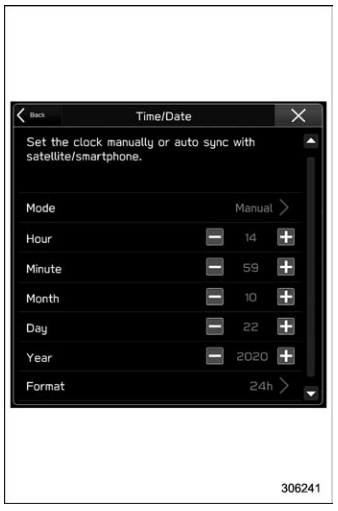
 to complete the
clock
setting.
to complete the
clock
setting.
