
Subaru Forester 2019-2025 Owners Manual / Instruments and controls / Ignition switch (models without “keyless access with push-button start
system”)
Subaru Forester: Instruments and controls / Ignition switch (models without “keyless access with push-button start system”)
WARNING
- Never turn the ignition switch to the “LOCK” position while the vehicle is being driven or towed because that will lock the steering wheel, preventing steering control. And when the engine is turned off, it takes a much greater effort than usual to steer.
- Before leaving the vehicle, always remove the key from the ignition switch for safety and never allow an unattended child to remain in the vehicle. Failure to follow this procedure could result in injury to a child or others. Children could operate the power windows, the moonroof or other controls or even make the vehicle move.
CAUTION
Do not attach a large key holder or key case to either key. If it banged against your knees or hands while you are driving, it could turn the ignition switch from the “ON” position to the “ACC” or “LOCK” position, thereby stopping the engine. Also, if the key is attached to a key holder or to a large bunch of other keys, centrifugal force may act on it as the vehicle moves, resulting in unwanted turning of the ignition switch.
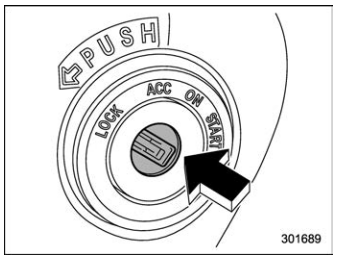
The ignition switch has four positions: LOCK, ACC, ON and START.
NOTE
- Keep the ignition switch in the “LOCK” position when the engine is not running.
- Using electrical accessories for a long time with the ignition switch in the “ON” or “ACC” position can cause the battery to go dead.
- If the ignition switch will not move from the “LOCK” position to the “ACC” position, turn the steering wheel slightly to the left and right as you turn the ignition switch.

 Key positions
CAUTION
Do not turn the ignition switch to the
“START” position while the engine
is running.
NOTE
To turn the key from the “ACC” to
“LOCK” position, the select lever must
be in the “P” position and the key must
be pushed in and turned...
Other information:
Subaru Forester 2019-2025 Owners Manual: Intelligent (I) mode
For smooth, efficient performance driving Type A Type B The linear acceleration characteristic of the Intelligent (I) mode is ideal for normal driving usage. The Intelligent (I) mode provides wellbalanced performance with greater fuel efficiency and smooth driveability without stress...
Subaru Forester 2019-2025 Owners Manual: Using the Driver Monitoring System . User recognition
User recognition When a user is registered with the user recognition function, the Driver Monitoring System performs the following. When the door is opened and the push-button ignition switch is OFF, the user recognition screen appears and the Driver Monitoring system starts user recognition...
Categories
- Manuals Home
- Subaru Forester Owners Manual
- Subaru Forester Service Manual
- Unlock using PIN Code Access
- Auto Start Stop warning light/Auto Start Stop OFF indicator light (yellow)
- All-Wheel Drive warning light
- New on site
- Most important about car
Windshield wiper and washer switches
The wiper operates only when the ignition switch is in the “ON” or “ACC” position.

Copyright © 2025 www.suforester5.com