
Subaru Forester 2019-2026 Owners Manual / Driving tips / Winter driving / Operation during cold weather / Parking in cold weather
Subaru Forester: Operation during cold weather / Parking in cold weather
WARNING
Snow can trap dangerous exhaust gases under your vehicle. Keep snow clear of the exhaust pipe and from around your vehicle if you park the vehicle in snow with the engine running.
CAUTION
- Do not use the parking brake when parking for long periods in cold weather since it could freeze in that position.
- When the vehicle is parked in snow or when it snows, raise the wiper blades off the glass to prevent damage to them.
- When the vehicle has been left parked after use on roads heavily covered with snow, or has been left parked during a snowstorm, icing may develop on the brake system, which could cause poor braking action. Check for snow or ice buildup on the suspension, disc brakes and brake hoses underneath the vehicle. If there is caked snow or ice, remove it, being careful not to damage the disc brakes, brake hoses or ABS harness.
When parking for long periods in cold weather, you should observe the following tips.
- Place the select lever in the “P” position.
- Use tire stops under the tires to prevent the vehicle from moving.

 Refueling in cold weather
To help prevent moisture from forming in
the fuel system and the risk of its freezing,
use of an antifreeze additive in the fuel
tank is recommended during cold weather...
Other information:
Subaru Forester 2019-2026 Owners Manual: Type C
Temperature control dial (Refer to “Automatic climate control operation”and/or “Temperature control”) AUTO button (Refer to “Automatic climate control operation”) Air conditioner button (Refer to “Air conditioner control”) Air inlet selection button (Refer to “Air inlet selection”) MAX A/C button (Refer to “MAX A/C mode (for type B and C)”) Defroster button (Refer to “Defrosting”) Rear window defogger button and outside mirror defogger button (Refer to “Defogger and deicer”) Airflow mode selection dial (Refer to “Airflow mode selection”) Fan speed control dial (Refer to “Fan speed control”) ON/OFF button (Refer to “Automatic climate control operation”) NOTE The climate control screen is displayed on the multi-function display (color LCD)...
Kia Telluride (LQ2, 2027-2026) Owner's Manual: AC inverter: (if equipped)
The available AC inverter supplies 115V/150W household-style power, allowing compatible electrical accessories and equipment to be operated directly from the Kia Telluride while driving or when the vehicle is running. Rated Voltage: AC 115V Maximum electric power: 150W Before using the AC inverter, carefully read the Kia Telluride owner's manual to help avoid electrical system damage, electric shock, or improper operation...
Categories
- Manuals Home
- If the passenger’s frontal airbag OFF indicator illuminates and the ON indicator turns off even when the front passenger’s seat is occupied by an adult
- Automatic door locking/unlocking
- Changing a flat tire
- New on site
- Most important about car
Clock/date screen
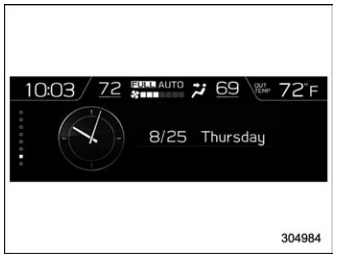
The time and date are displayed. You can adjust the time and date. For details, refer to “Clock”.

Copyright © 2026 www.suforester5.com