
Subaru Forester: Tires and wheels / Tire sidewall labeling
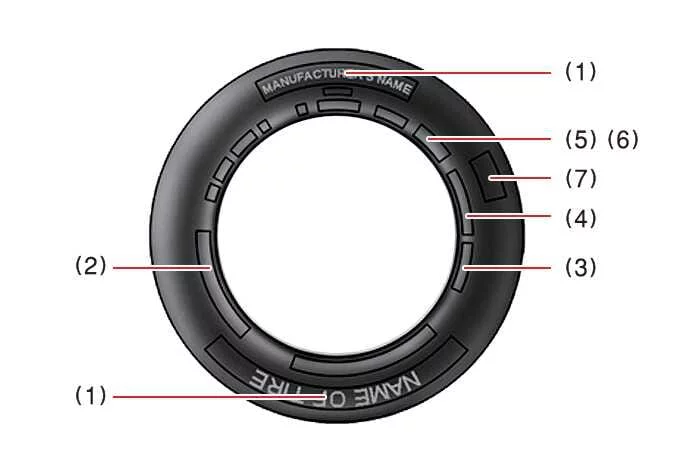
The standardized markings embossed onto the tire sidewall identify and describe the fundamental construction characteristics of the tire, while providing the official Tire Identification Number (TIN) required for safety standard compliance and verification.
|
The unique TIN serves as a critical reference number to identify the exact production batch of your tire in the event of a safety recall or manufacturer inspection.
1. Manufacturer or brand name
The sidewall prominently displays the trade name or trademark of the tire manufacturer or brand.
2. Tire size designation
Every tire sidewall is marked with an alphanumeric tire size designation. You will need to refer to this specific code when selecting suitable replacement tires for your Kia Telluride. The example breakdown below illustrates what each letter and number in the sizing sequence signifies.
(Note that these numbers are presented strictly as a structural example; the precise tire size designation installed on your vehicle may vary depending on trim level and factory option packages.)
Example tire size designation:
P255/45R20 105V
-
P: Indicates the applicable vehicle class (tires marked with the prefix P are intended primarily for passenger cars, crossovers, or light trucks; however, not all passenger-rated tires carry this prefix).
-
255: Denotes the nominal section width of the tire in millimeters from sidewall to sidewall.
-
45: Represents the aspect ratio, indicating the tire’s sidewall section height as a percentage of its section width.
-
R: Specifies the internal tire construction code (R stands for Radial ply construction).
-
20: Measures the matching wheel rim diameter in inches.
-
105: Identifies the Load Index, a numerical code corresponding to the maximum load capacity the tire can safely support when properly inflated.
-
V: Represents the Speed Rating Symbol. Refer to the speed rating chart provided in this section for maximum operating speed thresholds.
Wheel rims are also stamped with critical dimensional data that must be matched whenever you replace a wheel on your Kia Telluride. The following example outlines what each parameter in the wheel size rating indicates.
Example wheel size designation:
8.5JX20
-
8.5: Represents the actual rim width measured in inches between the inner flanges.
-
J: Designates the technical profile contour of the wheel rim flange.
-
20: Specifies the wheel rim diameter measured in inches.
The reference table below outlines the standardized speed rating symbols utilized across passenger vehicle tires. Integrated into the tire size string on the sidewall, this symbol indicates the maximum sustained speed for which the tire is engineered to operate safely under proper load and inflation conditions.
|
Speed Rating Symbol |
Maximum Speed |
|---|---|
|
S |
112 mph (180 km/h) |
|
T |
118 mph (190 km/h) |
|
H |
130 mph (210 km/h) |
|
V |
149 mph (240 km/h) |
|
W |
168 mph (270 km/h) |
|
Y |
186 mph (300 km/h) |
3. Checking tire life
Any tire that has reached 6 years of age based on its exact date of manufacture should be removed and replaced with a new unit. You can verify the production age on the sidewall casing (occasionally stamped on the inward-facing side) within the complete DOT code sequence. The DOT code comprises a combination of letters and numbers, with the final 4 digits specifically revealing the week and year of manufacture.
DOT: XXXX XXXX OOOO
The initial segments of the DOT string encode the manufacturing plant, tire size, and tread design pattern, while the trailing four digits disclose the production calendar week and year.
For example:
A code reading DOT XXXX XXXX 1626 indicates that the tire was manufactured during the 16th week of 2026.
WARNING
Tire age
Ensure tires are replaced promptly within the recommended service life limits. Continuing to drive on aged tires increases the risk of sudden structural tire failure or tread separation, which can lead to a loss of vehicle control, major collision, severe personal injury, or fatal accidents.
4. Tire ply composition and material
Tire ply rating indicates the total number of underlying fabric layers that form the structural body of the tire. Manufacturers explicitly list the underlying material composition, which commonly incorporates steel belts, nylon cords, polyester plies, or aramid reinforcement. The letter R indicates Radial ply structural design, D signifies Diagonal or bias ply construction, and B denotes a Belted-bias ply configuration.
5. Maximum Inflation Pressure
This value represents the absolute maximum limit of cold air pressure that the tire is engineered to withstand. Never inflate a tire beyond this maximum threshold under any circumstances. Always refer to the vehicle Certification label or driver B-pillar placard for the recommended daily operational inflation pressure of your Kia Telluride.
6. Maximum load rating
This figure specifies the maximum payload weight in kilograms and pounds that an individual tire is certified to carry. When outfitting your Kia Telluride with new tires, always choose units that equal or exceed the original factory load rating.
7. Uniform Tire Quality Grading
Quality ratings established under federal standards are molded onto the tire sidewall, typically positioned between the outer tread shoulder and maximum section width.
For example:
-
Treadwear 200
-
Traction AA
-
Temperature A
Rubber compounds naturally deteriorate over time due to environmental factors, even when the vehicle is infrequently driven or stored. Regardless of remaining tread depth, replacing tires after roughly 6 years of normal service is strongly advised. Consistent exposure to high ambient heat or frequent heavy vehicle load conditions will further accelerate rubber compound aging.
Tread wearThe treadwear grade provides a comparative index based on the wear rate of the tire during standardized testing on a specified government test course. For instance, a tire rated at 150 would demonstrate 1.5 times the tread life on that controlled course compared to a baseline tire graded at 100.
Actual tread mileage varies significantly depending on real-world driving conditions, individual driving habits, routine rotation and alignment practices, road surface roughness, and regional climatic variations.
Treadwear indicators are permanently molded into the sidewall rubber of passenger tires. Standard or optional tires equipped on your Kia Telluride may display different grade ratings based on wheel size and tire model variations.
Traction — AA, A, B, and CTraction grades, ordered from highest to lowest capability, are AA, A, B, and C. These ratings evaluate the tire’s straight-line braking performance on wet asphalt and concrete surfaces under controlled laboratory test conditions. A tire rated C offers minimal wet traction efficiency.
The assigned traction grade reflects straight-line deceleration stopping distance exclusively and does not measure cornering stability, hydroplaning resistance, wheel-spin acceleration traction, or peak lateral grip characteristics.
Temperature — A, B, and CTemperature resistance grades, ranked from highest to lowest as A, B, and C, measure the tire’s capacity to withstand internal heat build-up and effectively dissipate thermal energy when tested on a controlled indoor laboratory wheel setup.
Excessive internal operating temperatures cause structural rubber degradation, shorten casing lifespan, and potentially trigger sudden tire failure or tread blowout. Grade C fulfills the baseline performance standard mandated for all passenger car tires under Federal Motor Vehicle Safety Standard No. 109, whereas Grades B and A represent superior thermal endurance exceeding minimum statutory requirements.

 Checking tire inflation pressure
Routinely checking inflation pressure at least once a month—or prior to taking long road trips—is essential for maintaining optimal safety and handling performance in your Kia Telluride...
Other information:
Kia Telluride (LQ2, 2027-2026) Owner's Manual: Smart liftgate with auto open: (if equipped)
On Kia Telluride models equipped with a smart key, the Smart Liftgate with AUTO Open function provides convenient hands-free access to the cargo area. When the system detects the authorized smart key near the rear of the vehicle, it can automatically open the liftgate without requiring you to press any buttons...
Subaru Forester 2019-2026 Owners Manual: To install a child restraint system using lower and tether anchorages
WARNING Before installing a child restraint system, be sure to confirm that the seatback is securely locked into place. Otherwise, in an accident, serious injury or death could result. Shake the seatback slightly to confirm that it is securely locked into place...
Categories
- Manuals Home
- Daytime running light system
- To activate/deactivate the X-MODE
- How to use the high beam assist function
- New on site
- Most important about car
Windshield wiper and washer switches
The wiper operates only when the ignition switch is in the “ON” or “ACC” position.
