
Subaru Forester: Towing / Removable towing hook: (if equipped). Integrated recovery hook: (if equipped)

|
-
Open the liftgate, lift the cargo floor board, and retrieve the detachable towing eye hook stored securely inside the factory vehicle tool case.
-
Locate the circular access port on the bumper cover, then firmly press the edge of the access cap to pop it open and remove it.
-
Insert the threaded shaft of the towing hook into the exposed bumper socket and rotate it clockwise by hand until it threads smoothly, then tighten it completely until it is securely seated against the frame.
-
After completing the towing operation, unscrew the hook counterclockwise, store it safely back in the underfloor tool case, and snap the decorative bumper access cover firmly back into place.
Emergency towing

|
WARNING
-
Exercise extreme caution whenever flat-towing the vehicle on its own wheels. A licensed driver must remain seated inside the towed vehicle at all times to maintain directional steering control and operate the foot brakes manually.
-
Avoid abrupt acceleration, sudden braking, or erratic steering maneuvers that place severe shock loads on the emergency towing eyelet, rigging hardware, and towing strap or chain. Violent surges can cause the hardware or tow line to snap, creating a hazardous projectile that could lead to severe property damage or catastrophic personal injury.
-
If the disabled vehicle is stuck, immobilised, or unable to roll freely due to mechanical binding, do not attempt to force the vehicle forward using the emergency towing hook. Discontinue towing attempts immediately and contact an authorized Kia dealer or professional flatbed recovery service.
-
Position the recovery vehicle directly ahead and pull the disabled vehicle in a straight line whenever possible to prevent lateral stress on the threaded socket.
-
Keep all bystanders and non-essential personnel at a safe distance from both vehicles and the active tow line during recovery operations.
-
Use a heavy-duty commercial towing strap measuring under 16 ft (5 m) in length. Securely attach a bright white or red warning flag (approximately 12 inches / 30 cm wide) to the midpoint of the strap to ensure high visibility for surrounding traffic.
Figure 1. Front 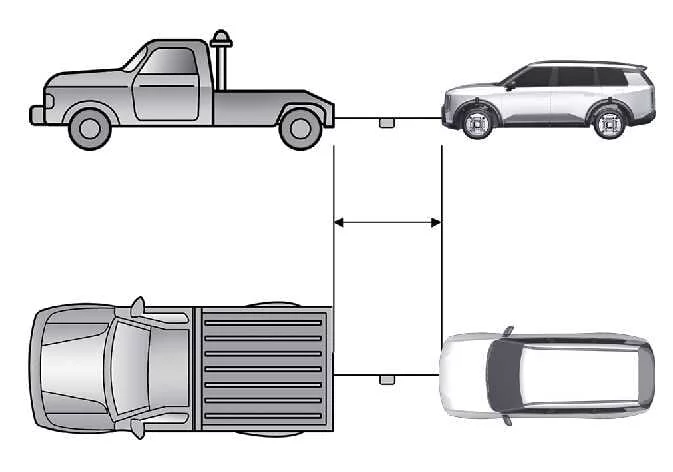
Figure 2. Rear (if equipped) 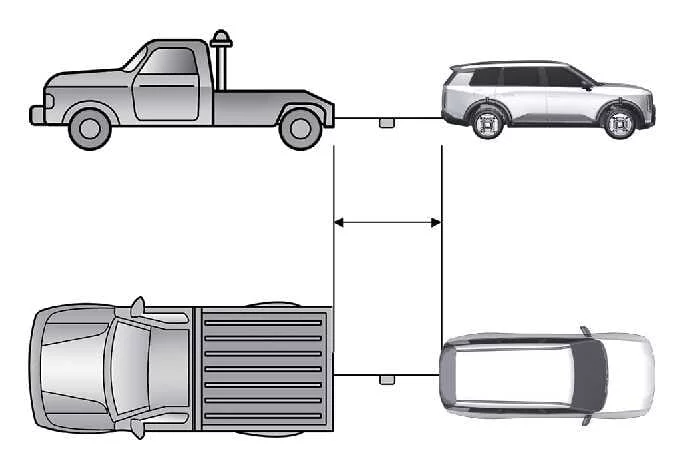
-
Maintain consistent throttle input and steady distance so the towing strap remains taut, preventing slack that could cause the line to drag on the pavement or snag beneath the tires.
-
A driver must remain behind the wheel of the towed Kia Telluride to operate steering and braking controls throughout the entire maneuver. Under no circumstances should passengers ride inside a vehicle being towed on flat ground.
NOTE
-
Attach the rated towing strap or cable exclusively to the designated threaded emergency towing hook.
-
Never hook tow cables or recovery straps to suspension arms, axle shafts, tie rods, or body bumpers, as doing so can inflict severe structural frame damage to your vehicle.
-
Utilize only high-strength cables, straps, or chains specifically manufactured for vehicle recovery. Ensure all clevis pins or hooks are fully latched and fastened securely onto the eyelet.
-
Accelerate and decelerate smoothly and gradually, maintaining constant tension on the tow line when moving off or stopping, as violent jerking movements can pull the eyelet out of its mounting threads or damage chassis components.
NOTE
-
Flat-towing using the emergency hook is permitted only over short distances at low speeds on paved, hard-surfaced roads. Furthermore, all rolling components—including wheels, hubs, axles, driveshafts, steering linkages, and hydraulic brakes—must be fully functional and intact.
-
Do not attempt to use the emergency recovery eyelets to pull a stranded vehicle out of deep mud, soft beach sand, snowbanks, or ditch inclines where the vehicle cannot move under its own power.
-
Never attempt to tow a heavier vehicle with a lighter recovery vehicle, as the trailing mass can easily overpower the tow vehicle's traction and braking capacity.
-
Establish clear communication signals between the drivers of both vehicles prior to moving, and check in frequently throughout the transport process.
-
Thoroughly inspect the emergency towing hook for hairline fractures, metal fatigue, or damaged threads prior to mounting it to the vehicle bumper socket.
-
Double-check that the towing line hardware is latched cleanly and securely around the loop of the eyelet before applying tension.
-
Never apply abrupt snatch loads or yank on the hook. Apply pull force in a smooth, continuous, and controlled manner.
-
To avoid bending the hook or damaging the bumper aperture, pull directly straight ahead. Never exert force at steep vertical or sharp side angles.
-
Switch the ignition switch or engine start button to the ON position so the steering wheel lock disengages, allowing full directional control of the front wheels.
-
Move the transmission gear selector into the N (Neutral) position.
-
Fully disengage the electronic parking brake before the vehicle begins rolling.
-
Depress the brake pedal with significantly greater force than required during normal driving, as hydraulic power brake assistance is unavailable while the engine is turned off.
-
Prepare for substantially increased steering effort at the wheel, as the power steering assist motor will be inactive without the engine running.
-
When descending long downhill grades, unassisted friction braking can generate excessive thermal buildup, leading to severe brake fade. Stop periodically in a safe area to allow the brake rotors and pads time to cool down.
-
Keep towing speeds strictly below 15 mph (25 km/h) and limit the overall towing distance to a maximum of 12 miles (20 km).
-
To safeguard internal automatic transmission components against heat damage caused by lack of internal fluid circulation, restrict towing speed to under 10 mph (15 km/h) and total distance to less than 1 mile (1.5 km).
NOTE
Transmission
-
When emergency flat-towing a Kia Telluride with all four wheels contacting the road, the vehicle must always be pulled forward from the front towing eyelet. Verify that the gear selector is locked in N (Neutral) and that the ignition is set to the ACC or ON position to unlock the steering column. An alert driver must remain in the vehicle cabin throughout the move to steer and brake safely.
-
Prior to flat-towing, perform a thorough visual check under the engine bay and subframe for fluid puddles or active transmission leaks. If automatic transmission fluid is leaking, do not flat-tow the vehicle; transport it exclusively using flatbed car carrier equipment or a wheel-lifting towing dolly.
Integrated recovery hook: (if equipped)
Depending on the specific trim level and regional package, integrated recovery hooks are anchored directly to the front and rear structural frame points of the vehicle. These heavy-duty attachment points are designed specifically for off-road extraction scenarios, allowing your Kia Telluride to be safely pulled out when immobilized in soft terrain, mud, deep snow, or sand and guided back onto drivable ground.
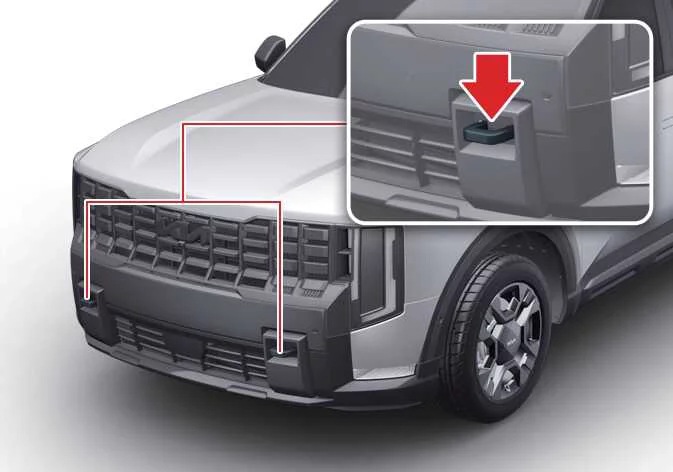
|

|
Integrated recovery hook precautions
-
Inspect all connection points, shackles, and mounting assemblies prior to rigging to verify that every component is fully secured and structurally rated to withstand the required pull load.
-
Do not use steel chains, wire cables, or recovery straps fitted with rigid metal hook ends, as these can detach under tension and pose extreme safety hazards.
-
Utilize high-grade synthetic kinetic recovery straps or kinetic ropes featuring a certified minimum breaking strength rated at two to three times the total gross vehicle weight of the immobilized Kia Telluride.
-
Thoroughly examine the full length of the recovery strap before attaching it, ensuring the webbing is in good working order and completely free of frayed edges, visible cuts, surface abrasion, or structural stitching damage.
-
Drape a heavy-duty line damper device—such as a dedicated recovery damper bag, weighted tarp, heavy blanket, or thick piece of carpet—over the center of the recovery strap to absorb recoil energy in the event of strap or hardware failure.
WARNING
-
Integrated recovery hooks must be operated exclusively by individuals trained in proper off-road extraction protocols and vehicle recovery safety practices. Improper rigging, incorrect pulling angles, or misuse of equipment can cause hook failure or separation from the chassis, resulting in severe vehicle damage, serious personal injury, or death.
-
Always ease the recovery vehicle forward to gently remove all slack from the recovery strap before applying full pulling force. Applying sudden shock loads or snatching against a loose strap can cause the recovery hooks to snap or the strap to burst violently, leading to serious personal injury or fatal accidents.
-
Never join two recovery straps together using a steel clevis pin, shackle, or metal bolt. If either strap snaps under load, the metal pin or hardware becomes a high-velocity projectile capable of causing lethal injury or extreme damage.
-
Never exert side-pull force on the integrated recovery hooks. Pulling at sharp lateral angles can fracture the mounting welds or twist the bumper frame. Always align the recovery vehicle to pull the stranded Kia Telluride straight ahead from the front or straight back from the rear.
NOTE
Do not subject the recovery hooks to tensile loads that exceed the total Gross Vehicle Weight Rating (GVWR) of your Kia Telluride, as excessive force can deform the underlying frame structures.

 Maintenance
..
Other information:
Subaru Forester 2019-2026 Owners Manual: Favorite setting
Select “Favorite” from the 2nd menu in setting screen. Refer to “Setting screen”. Set the desired items by using the control switches. For details about items, refer to “Favorite screen”. Select “Set” to exit settings. Select “Go Back” to return to the previous screen without applying the setting changes...
Subaru Forester 2019-2026 Owners Manual: Manual rear gate
The rear gate can be locked and unlocked using any of the following systems. Power door locking switch: Refer to “Locking and unlocking from the inside”. Keyless access with the push-button start system (if equipped): Refer to “Keyless access with push-button start system”...
Categories
- Manuals Home
- Daytime running light system
- Alarm system setting
- Reverse Automatic Braking (RAB) system ON/OFF setting
- New on site
- Most important about car
Outside temperature indicator
The outside temperature is displayed on the multi-function display (color LCD).
NOTE
The outside temperature indicator shows the temperature around the sensor. However, the temperature may not be indicated correctly or the update may be delayed in the following conditions. While parking or driving at low speeds When the outside temperature changes suddenly (example: when going in and out of an underground parking area or when passing through a tunnel) When starting the engine after being parked for a certain period of time The temperature unit cannot be changed.