
Subaru Forester 2019-2026 Owners Manual / Driving tips / Loading your vehicle / Roof rails (if equipped)
Subaru Forester: Loading your vehicle / Roof rails (if equipped)
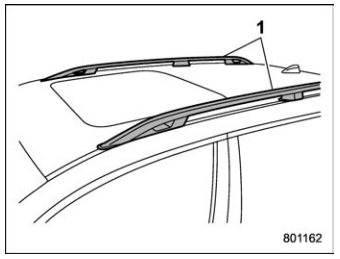
- Roof rails
Cargo can be carried on the roof after securing the crossbars to the roof rails and installing an appropriate carrying attachment. When installing crossbars and a carrying attachment, follow the manufacturer’s instructions. The roof rail system is designed to carry loads (cargo, crossbars and carrying attachment) of no more than 176 lbs (80 kg). Be sure not to exceed your vehicle’s GVWR and GAWR.
CAUTION
- When using a carrying attachment, make sure that the total carrying load of the cargo, crossbars and carrying attachment does not exceed 176 lbs (80 kg). Overloading may cause damage to the vehicle. Read the manufacturer’s instructions and pay attention to not exceed the load limit of the parts.
- For cargo carrying purposes, the roof rails must be used together with the SUBARU recommended crossbars and any appropriate carrying attachment that may be needed. The roof rails must never be used alone to carry cargo. Otherwise, damage to the roof or paint, or a dangerous road hazard due to loss of cargo could result.
NOTE
- Remember that the vehicle’s center of gravity is altered with the weight of the load on the roof, thus affecting driving characteristics.
- Drive carefully. Avoid rapid starts, hard cornering and abrupt stops. Crosswind effects will be increased.
 GVWR and GAWR (Gross Vehicle Weight Rating and Gross Axle Weight Rating)
Certification label
The certification label attached to the
bottom of driver’s side door pillar shows
GVWR (Gross Vehicle Weight Rating) and
GAWR (Gross Axle Weight Rating).
The GVW (Gross Vehicle Weight) must
never exceed the GVWR. GVW is the
combined total of weight of the vehicle,
fuel, ..
 Roof tent (models with roof rails)
WARNING
Adding weight to the vehicle’s roof
can adversely affect handling, braking,
and rollover resistance. The
vehicle must never be driven with a
total roof rail load in excess of 176
lbs (80 kg)...
Other information:
Kia Telluride (LQ2, 2027-2026) Owner's Manual: Liftgate
WARNING Exhaust fumes Never drive your Kia Telluride with the liftgate open unless it is absolutely necessary. An open liftgate can allow hazardous exhaust gases to enter the passenger compartment, creating a serious risk of injury or death. If driving with the liftgate open cannot be avoided, keep all windows open and set the ventilation system to allow a continuous flow of fresh outside air into the cabin...
Kia Telluride (LQ2, 2027-2026) Owner's Manual: Evasive Steering Assist function: (if equipped)
The Evasive Steering Assist function for Forward Collision-Avoidance Assist provides Emergency Steering support when the Kia Telluride detects that steering assistance may help the driver avoid or reduce the severity of a collision. Emergency Steering (Driver steering assist) Emergency Steering Emergency Steering can alert the driver with a blinking Emergency steering warning light (), a warning message, an audible warning, and steering wheel vibration...
Categories
- Manuals Home
- Power steering warning light
- Auto Start Stop warning light/Auto Start Stop OFF indicator light (yellow)
- Unlock using PIN Code Access
- New on site
- Most important about car
Average fuel consumption
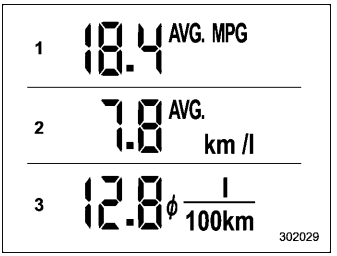
This display shows the average rate of fuel consumption since the trip meter was last reset.

Copyright © 2026 www.suforester5.com