
Subaru Forester 2019-2026 Owners Manual / Driving tips / Loading your vehicle
Subaru Forester: Driving tips / Loading your vehicle
WARNING
- Never allow passengers to ride on a folded rear seatback in the cargo area. Doing so may result in serious injury.
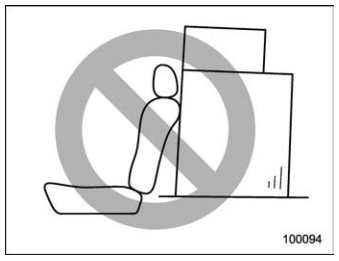
- Never stack luggage or other cargo higher than the top of the seatback because it could tumble forward and injure passengers in the event of a sudden stop or accident. Keep luggage or cargo low, as close to the floor as possible.
WARNING
- When you carry something inside the vehicle, secure it whenever you can to prevent it from being thrown around inside the vehicle during sudden stops, sharp turns or in an accident.
- Do not pile heavy loads on the roof. These loads raise the vehicle’s center of gravity and make it more prone to tip over.
- Secure lengthy items properly to prevent them from shooting forward and causing serious injury during a sudden stop.
- Never exceed the maximum load limit. If you do, some parts on your vehicle can break, or it can change the way your vehicle handles. This could result in loss of control and cause personal injury. Also, overloading can shorten the life of your vehicle.
- Do not place anything on the extended cargo area cover. Such items could tumble forward in the event of a sudden stop or a collision. This could cause serious injury.
CAUTION
Do not carry spray cans, containers with flammable or corrosive liquids or any other dangerous items inside the vehicle.
NOTE
For better fuel economy, do not carry unneeded cargo.
- Vehicle capacity weight
- GVWR and GAWR (Gross Vehicle Weight Rating and Gross Axle Weight Rating)
- Roof rails (if equipped)
- Roof tent (models with roof rails)

 Vehicle capacity weight
Vehicle placard
The load capacity of your vehicle is
determined by weight, not by available
cargo space. The maximum load you can
carry in your vehicle is shown on the
vehicle placard attached to the driver’s
side door pillar...
Other information:
Subaru Forester 2019-2026 Owners Manual: System features
In the event of wheelspin and/or skidding on a slippery road surface and/or during cornering and/or an evasive maneuver, the Vehicle Dynamics Control system adjusts the engine’s output and the wheels’ respective braking forces to help maintain traction and directional control...
Subaru Forester 2019-2026 Owners Manual: Type A
Turn the airflow mode selection dial and fan speed control dial to the “AUTO” position. Set the preferred temperature using the temperature control dial. NOTE Each function can be individually set to the “AUTO” mode independently of the other functions...
Categories
- Manuals Home
- Disabling functions
- Low fuel warning light
- RAB warning light (if equipped)
- New on site
- Most important about car
Driving information display
NOTE
You can set the units for both the multifunction display (black and white) and the combination meter at the same time. For details about setting the language and units, refer to “Type A combination meter” or “Menu screens”.

Copyright © 2026 www.suforester5.com