
Subaru Forester 2019-2026 Owners Manual / In case of emergency / Towing / Towing with all wheels on the ground
Subaru Forester: Towing / Towing with all wheels on the ground
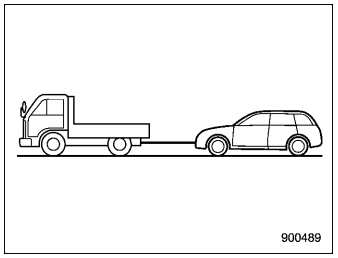
- Release the parking brake and put the transmission in the neutral position.
- The ignition switch should be in the “ON” position while the vehicle is being towed.
- Take up slack in the towline slowly to prevent damage to the vehicle.
WARNING
- Never turn the ignition switch to the “LOCK”/“OFF” position while the vehicle is being towed because the steering wheel and the direction of the wheels will be locked.
- Remember that the brake booster and power steering do not function when the engine is not running. Because the engine is turned off, it will take greater effort to operate the brake pedal and steering wheel.
CAUTION
- If transmission failure occurs, transport your vehicle on a flatbed truck.
- Sometime damaged vehicles cannot be towed because of their damaged condition. In that case, use a flat-bed truck for transportation.
- The traveling speed must be limited to less than 20 mph (32 km/h) and the traveling distance to less than 31 miles (50 km). For greater speeds and distances, transport your vehicle on a flatbed truck.
- Use a flat-bed truck if there are long distance downgrades or steep slopes. However, do not apply the brake pedal for a long time because the engine braking will not work while towing. Doing so could overheat the brake.
- Drive carefully and do not make an impact on the towing rope by suddenly starting.
- Use a specific towing rope for towing. If wire ropes and metal chains are needed to be used for towing, wrap the contact portion of the bumper with cloth to protect it from damage.

 Access key fob – if access key fob does not operate properly
CAUTION
Keep metallic objects, magnetic
sources and signal transmitters
away from the area between the
access key fob and the push-button
ignition switch...
Other information:
Subaru Forester 2019-2026 Owners Manual: Fuse panel located in the passenger compartment
..
Subaru Forester 2019-2026 Owners Manual: Gross Vehicle Weight (GVW) and Gross Vehicle Weight Rating (GVWR)
Gross Vehicle Weight The Gross Vehicle Weight (GVW) must never exceed the Gross Vehicle Weight Rating (GVWR). Gross Vehicle Weight (GVW) is the combined total of the weight of the vehicle, driver, passengers, luggage, trailer hitch, trailer tongue load and any other optional equipment installed on your vehicle...
Categories
- Manuals Home
- Reclining the seatback (if equipped)
- Automatic door locking/unlocking
- Vehicle load limit – how to determine
- New on site
- Most important about car
How to get the source code using the open source
Free/Open Source Software Information
This product contains Free/Open Source Software (FOSS).
The license information and/or the source code of such FOSS can be found at the following URL.
http://www.globaldenso.com/en/opensource/ivi/subaru/

Copyright © 2026 www.suforester5.com