Subaru Forester: Forward Collision-avoidance Assist operation / Evasive Steering Assist function: (if equipped)
The Evasive Steering Assist function for Forward Collision-Avoidance Assist provides Emergency Steering support when the Kia Telluride detects that steering assistance may help the driver avoid or reduce the severity of a collision.
Emergency Steering (Driver steering assist)
|
|
Emergency Steering can alert the driver with a blinking Emergency steering warning light ( ), a warning message, an audible warning, and steering wheel vibration.
If the system detects a risk of collision with a vehicle, pedestrian, cyclist, or motorcyclist ahead of your vehicle, Emergency Steering can assist your steering input to help avoid the collision or reduce the chance of impact.
Emergency Steering may activate under the following condition:
Your driving speed: Approximately 25-53 mph (40-85 km/h)
Emergency Steering (Evasive steering assist)
|
|
|
Emergency Steering can alert the driver with a blinking Emergency steering warning light (), a warning message, an audible warning, and steering wheel vibration.
If there is a risk of collision with a pedestrian, cyclist, or motorcyclist ahead and the vehicle has already exceeded the Emergency Braking speed limit, Emergency Steering can activate to help the driver steer away from the hazard.
Emergency Steering may activate under the following conditions:
-
Your driving speed is approximately 40-47 mph (65-75 km/h).
-
The pedestrian, bicyclist, or motorcycle is moving in the same direction as your vehicle or in the opposite direction.
-
Both lane markings are detected.
-
The Kia Telluride is traveling on a straight road.
-
There is no detected risk of a secondary collision.
WARNING
-
When Emergency Steering is operating, the steering wheel may turn automatically. Keep your hands on the wheel and remain prepared to take control.
-
Emergency Steering automatically ends when the risk factors are no longer present. Adjust the steering wheel as needed to keep the vehicle safely positioned.
-
Emergency Steering may deactivate during operation if the steering wheel is held tightly or turned in the opposite direction.
-
When steering assistance is being provided to help avoid a collision with another vehicle, pedestrian, or cyclist, Evasive steering assist will deactivate if the system detects a possible collision with other vehicles, motorcyclists, pedestrians, or cyclists.
-
Evasive steering assist may not operate if there is not enough clear space around the vehicle to avoid the collision safely.
-
When driving at night, powered two-wheeler recognition performance may decrease, so Forward Collision-Avoidance Assist may be temporarily limited or may not operate as expected.
TIP
For more information about warning messages, refer to Collision Warning.
WARNING
-
For your safety, change the system settings only after parking the vehicle in a safe location.
-
Forward Collision-Avoidance Assist does not operate in every situation and cannot prevent every collision.
-
The driver is always responsible for controlling the vehicle. Do not rely solely on Forward Collision-Avoidance Assist. Maintain a safe following distance and press the brake pedal manually whenever you need to slow down or stop the vehicle.
-
Never deliberately drive toward people, vehicles, or objects to test Forward Collision-Avoidance Assist. Doing so can cause serious injury or death.
-
Forward Collision-Avoidance Assist may not operate if you manually brake to avoid a collision.
-
Depending on road and driving conditions, Forward Collision-Avoidance Assist may warn the driver late or may not provide a warning.
-
During Forward Collision-Avoidance Assist operation, the vehicle may stop suddenly. Loose objects can shift inside the cabin and may injure passengers, so all occupants should fasten seat belts and loose items should be secured before driving.
-
Forward Collision-Avoidance Assist may not display a warning message or sound its warning if another function's warning message or audible warning is already active at the same time.
-
You may not hear the Forward Collision-Avoidance Assist warning sound in noisy surroundings.
-
Depending on road conditions and the surrounding environment, Forward Collision-Avoidance Assist may turn OFF, operate improperly, or activate unnecessarily.
-
Emergency Braking activated by Forward Collision-Avoidance Assist may end automatically if you brake hard or turn the steering wheel sharply.
WARNING
-
The surrounding environment can affect the speed range and detection range of Forward Collision-Avoidance Assist, which may cause the function to become temporarily limited or disabled.
-
Forward Collision-Avoidance Assist evaluates the oncoming vehicle's direction, speed, and surrounding conditions when judging collision risk.
-
Forward Collision-Avoidance Assist may not activate when driving at high speed or when there is a large speed difference between your vehicle and oncoming vehicles.
-
If the system determines that a collision with surrounding vehicles is likely, the Lane Change Oncoming, Lane Change Side, and Evasive Steering Assist functions will provide warnings only and will not provide steering control.
TIP
-
When a collision is imminent, Forward Collision-Avoidance Assist may activate brake assist if the driver's braking input is not sufficient to help avoid the collision.
-
The images, icons, and colors shown on the display may vary depending on the instrument cluster specifications or selected theme.
-
If the interior camera detects an abnormal driver condition, Forward Collision-Avoidance Assist may activate earlier than usual: (if equipped)
 Lane-Change Side function: (if equipped)
The Lane-Change Side function of Forward Collision-Avoidance Assist is designed to help support the driver when moving toward a lane where another vehicle or motorcyclist may be approaching from the rear side. In the Kia Telluride, this function may provide assistance through the following stages:
..

Other information:
Kia Telluride (LQ2, 2027-2026) Owner's Manual: Fuel requirements
Your new Kia Telluride is engineered to operate only on unleaded fuel with a pump octane number ((R+M)/2) of 87, which corresponds to Research Octane Number 91, or higher. Methanol-blended fuels must not be used, as they can interfere with proper drivability and may damage important fuel and emission-related components...
Kia Telluride (LQ2, 2027-2026) Owner's Manual: Operating the power liftgate
Power liftgate open/close button (smart key, instrument panel): (if equipped) Press and hold the power liftgate open/close button for approximately one second...
Categories
- Manuals Home
- All-Wheel Drive warning light
- Reverse Automatic Braking (RAB) system ON/OFF setting
- How to use the high beam assist function
- New on site
- Most important about car
Average fuel consumption
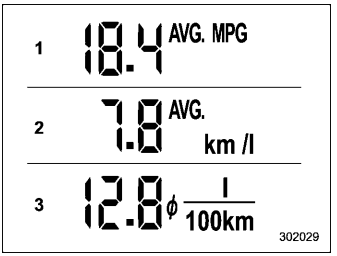
This display shows the average rate of fuel consumption since the trip meter was last reset.